Chinese Factories Are Moving to Vietnam - But What Does That Actually Mean?
When people say that Chinese factories are moving to Vietnam, the real question is not the label. The real question is what actually happens inside the Vietnamese factory: what is produced there, what still comes from China, and whether the commercial logic still works after duties, logistics and origin rules.
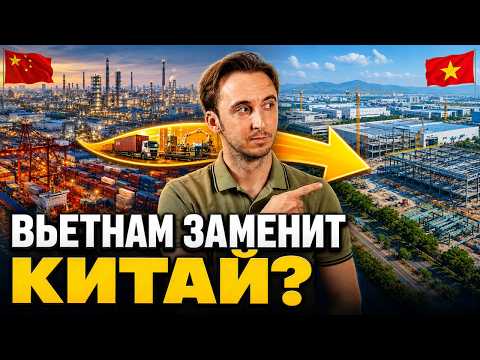
The phrase “Chinese factories are moving to Vietnam” appears so often that it has started to sound self-explanatory.
China is becoming more expensive, tariffs are rising, companies need another production base, so they move their factories south.
The reality is more complicated.
Sometimes Vietnam becomes a genuine manufacturing alternative. A product is made at a local plant, receives Vietnamese origin and reaches the buyer under significantly better commercial conditions.
In other cases, Vietnam adds little more than another border crossing, several weeks of transportation and an additional margin. The factory may be real, the documents may be valid and the certificate of origin may be genuine, yet the entire arrangement still makes no economic sense.
I encountered both situations in my own work.
In one transaction, routing supply through Vietnam increased the cost of a container from approximately €33,000 to €43,000.
In another, Vietnamese origin helped the importer avoid an anti-dumping duty that reached almost 35% for certain Chinese manufacturers.
A Vietnamese factory that depended entirely on China
Several years ago, I worked on a case involving paper supplied in large rolls. It was a specialised packaging material used to make boxes for tea, cosmetics, perfume and many other consumer products.
The product looked relatively simple, so the original assumption seemed reasonable: Vietnam should manufacture it locally.
We found a factory, received an acceptable offer and ordered a trial shipment consisting of one full container. The supplier was a real operating enterprise. The Vietnamese certificate of origin was valid, and there was nothing suspicious in the export documentation.
The next question was transportation to Europe.
Sea freight would have taken roughly one and a half to two months, which was too long for the project. We therefore chose a rail route. The container left Vietnam, entered China, was transferred to the railway system and continued towards Europe.
There is also a direct railway crossing between the two countries, but the Vietnamese and Chinese rail networks use different track gauges. Containers still need to be transferred between trains, and departures can involve additional waiting time.
The shipment eventually arrived, but later we discovered a detail that changed our understanding of the entire deal.
The material itself had not been produced in Vietnam. The Vietnamese factory purchased large rolls from China, transported them across the border and then cut and processed them to the required specifications.
These operations were sufficient for the finished product to qualify for Vietnamese origin under the applicable rules.
Nothing about the arrangement was necessarily illegal. The factory performed genuine production operations, and the certificate was not fake.
The problem was commercial rather than legal.
Part of the difference came from the higher selling price in Vietnam. The rest came from the route itself. The original material travelled from China to Vietnam, was processed there, and then travelled back through China on its way to Europe.
The transaction also consumed several additional weeks.
This difference was particularly painful because packaging paper is relatively inexpensive and heavy. Margins are calculated very carefully, often down to small differences in the price per tonne.
Commercial risk: Vietnamese origin provided no compensation in this case. We paid for a more expensive product and a longer route without receiving any tariff advantage in return.
Why Vietnam could not compete on price
The reason became much clearer when I later visited a genuine paper producer in China.
I asked the company’s representatives how many factories they operated. They showed me one production site containing approximately forty industrial buildings. Inside were enormous papermaking machines producing everything from heavy packaging board to thin paper used for books.
According to the company, this was only one of six sites operated by the group in different parts of China.
Seeing the scale made the price difference easy to understand.
Scale matters: China has an enormous domestic market, extensive production capacity, specialised equipment and dense networks of suppliers. Lower labour costs in Vietnam could not compensate because most of the product’s value had already been created in China.
For this particular transaction, Vietnam was not an alternative manufacturing base. It was an additional step between the real producer and the buyer.
When Vietnamese origin changed the entire calculation
The second case produced the opposite result.
A business owner I knew operated a fleet of around fifty buses. He had previously purchased truck and bus tyres from China. Chinese manufacturers offered a strong selection, acceptable quality and competitive factory prices.
The problem appeared at customs.
Truck tyres from China were subject to an anti-dumping duty. For products from certain Chinese manufacturers, the additional charge reached almost 35% of the customs value.
The owner asked me to look at Vietnam as an alternative country of supply.
At the time, I did not associate Vietnam with truck tyres. I knew the country as a major producer of furniture, textiles, food and agricultural products, but tyres were not an obvious category.
The review led to Casumina, an established Vietnamese manufacturer producing truck and bus tyres for domestic and export markets.
This was not a warehouse relabelling imported tyres. It was a genuine tyre manufacturer with its own production history and operating facilities.
We requested the required models, checked the dimensions and load ratings, and compared prices. Vietnam could not offer the same range as China, but the factory had suitable products and the quality was acceptable.
The decisive difference appeared when we calculated the import duties.
At the time of the transaction, Vietnamese tyres were not covered by the anti-dumping measure applied to Chinese products. They entered under the standard import duty without the additional charge that could approach 35%.
In this case, Vietnamese origin was not simply a statement on the documents. It materially changed the economics of the shipment.
Why Chinese manufacturers are building plants in Vietnam
The tyre industry also demonstrates one of the main reasons Chinese companies are investing in Vietnamese production.
Chinese tyres face substantial trade restrictions in several major markets. In the United States, additional duties for some producers have reached very high levels. The European Union has applied its own measures since 2018. Other markets have introduced or considered similar protection.
Under those conditions, the location of production can completely change the final cost.
This has encouraged Chinese tyre groups to build factories in Vietnam. A major tyre cluster has already developed in the south of the country, producing passenger, truck and industrial tyres. Local natural rubber can also be used in production.
Origin logic: the company may be Chinese, the machinery may come from China, and Chinese engineers may help launch the factory. That does not automatically make the final product Chinese if the product is genuinely manufactured in Vietnam and meets the relevant origin requirements.
The same logic appears in electronics, solar equipment, furniture, textiles and other industrial sectors.
However, not every factory follows the same model.
Three very different forms of manufacturing in Vietnam
The third model is the most important change taking place in Vietnam today.
China was already inside Vietnamese manufacturing
Vietnam has been producing complex goods for many years.
Samsung began manufacturing mobile phones in the country in 2009 and has since produced hundreds of millions of devices. Intel has assembled and tested semiconductor products in Vietnam since the mid-2000s. Apple suppliers manufacture headphones, tablets and watches there. Major global footwear brands have relied on Vietnamese factories for decades.
Historically, much of this industrial system was built by companies from South Korea, Taiwan, Japan and the United States.
Mainland China often played a different role: Chinese suppliers provided machinery, fabrics, chemicals, industrial materials, packaging and components to factories located across the border in Vietnam.
China was already deeply embedded in Vietnamese industry. What is changing now is the role: Chinese companies are increasingly building their own facilities inside Vietnam.
South Korea remains ahead in terms of total accumulated investment because Korean companies entered the country earlier and had more time to build large operations.
But the picture looks different when we focus on new projects. In 2024, Chinese investors accounted for around 28% of newly registered foreign-invested projects in Vietnam, close to one in every three.
This is no longer a marginal trend.
Tariffs are only part of the explanation
Trade restrictions receive most of the attention, but Chinese companies have other reasons to expand production into Vietnam.
One of them is supply-chain resilience.
After the pandemic, major buyers became less willing to depend entirely on a single country. A regional shutdown, port closure or transportation restriction could suddenly make a previously reliable product unavailable.
Large customers therefore ask suppliers more questions than they did before. They want to know whether production is available in a second country, how quickly a model can be transferred there and how long it would take to switch capacity if the original factory were disrupted.
For some Chinese suppliers, the absence of a second production location can now mean losing a contract.
Another reason is the growth of Southeast Asia itself. The region is not simply a route to the United States or Europe. It is a major consumer market with hundreds of millions of people, expanding cities and growing demand for electronics, household appliances and electric transport.
Vietnam’s main geographical advantage
Northern Vietnam lies directly beside one of China’s most important industrial regions.
The border is close. Hai Phong port is accessible. Roads and industrial zones are already operating.
When a Vietnamese factory lacks a component, it can often receive it from China within days. Engineers do not need to travel halfway across the world to support a production line. Spare parts and equipment manufacturers remain nearby.
This proximity gives Vietnam a major advantage over countries that are much farther from China and must recreate complete supply chains from the beginning.
How one factory turns into an industrial cluster
A large electronics plant may need thousands of plastic housings every day.
Initially, those housings can be imported from China. Over time, however, transporting every unit across the border becomes inefficient. Eventually, a supplier opens a moulding facility near the main factory.
A cable producer may follow. Then packaging companies, metalworking plants, fastener suppliers and manufacturers of protective materials arrive.
What began as one large factory gradually becomes a network of businesses serving one another.
Real industrial change: an investment certificate does not manufacture anything. A functioning supply chain does.
China developed in a similar way. A foreign manufacturer arrived first. Its suppliers followed. Industrial towns formed around the resulting network. Local engineers, equipment makers and eventually domestic global companies emerged from that environment.
Vietnam has reached that level only in selected sectors, but the network is expanding.
The signs appear before the factory opens
The arrival of new manufacturing projects can sometimes be seen before production begins.
I regularly look through Vietnamese recruitment websites, and vacancies requiring Chinese language skills have become increasingly common.
These are not limited to translators. Companies are recruiting procurement specialists, engineers, quality-control employees and production managers who can work in Chinese.
The factory may not yet have shipped a single commercial order, but the operating team is already being assembled.
What Vietnam is beginning to produce
Vietnam has assembled finished electronics and household appliances for years. The newer development is the arrival of factories producing more of the parts inside those products.
However, the presence of a new factory should not be confused with a mature market.
In many emerging Vietnamese industries, there may currently be only one or two suitable producers. In China, the same product may be offered by dozens of factories supported by hundreds of specialised suppliers.
If announced projects are completed and reach their intended capacity, Vietnam may offer genuine supplier choice in more of these categories within the next several years.
For now, the process is still developing.
A device can be assembled in Vietnam. Its housing, cable or circuit board may also be made locally. But the processor, memory, specialised chip or chemical material may still come from China, South Korea, Japan or Taiwan.
A real factory does not eliminate trade risk
Even a fully operating factory does not guarantee permanent protection from tariffs or trade investigations.
The solar industry provides a clear example.
Chinese companies built genuine production plants in Vietnam. These were not warehouses replacing labels on imported goods. They contained equipment, employees and real production lines manufacturing solar cells and finished panels.
The commercial logic was understandable. Chinese solar products faced restrictions in the United States, so companies moved part of their manufacturing to Vietnam.
American authorities then examined the supply chain more closely.
Trade risk: a finished panel might be assembled in Vietnam, but the origin of the silicon wafers, glass, aluminium frames and protective materials still mattered.
In some cases, authorities concluded that the processing in Vietnam was not sufficient to change the product’s origin.
The situation later became even more complex. The United States launched separate anti-dumping and countervailing-duty investigations into solar products from Vietnam itself.
In April 2025, the US authorities announced final affirmative determinations in those investigations.
The factories were real. Companies had invested capital, installed equipment, employed workers and transferred genuine production. They still did not eliminate the trade risk.
Tariff advantages do not last forever
The tyre transaction also had a later development.
At the time of the shipment, Vietnamese truck tyres were not covered by the anti-dumping surcharge applied to Chinese products.
On 11 November 2025, however, the Eurasian Economic Commission opened a separate anti-dumping investigation into truck tyres originating from Vietnam and Thailand.
An investigation does not mean that an additional duty has already been imposed. But it sends a clear signal.
Practical point: when exports from a new production country grow rapidly, trade restrictions can follow them. A tariff advantage that worked several years ago cannot automatically be included in the next purchasing calculation.
What this means for buyers
The list of products worth reviewing in Vietnam needs to be updated regularly.
Categories that were previously available almost exclusively in China are beginning to appear in Vietnam. At the same time, supplier choice in many industries remains limited. Buyers may see one or two Vietnamese producers compared with dozens of alternatives in China.
A Vietnamese factory also does not automatically mean a lower price.
In the paper transaction, the main value of the product had already been created in China. Vietnam added transportation, processing costs and margin.
In the tyre transaction, the difference in import duties outweighed the other costs and made Vietnam commercially attractive.
Each deal must be calculated on its own.
A project mentioned in the news should not yet be treated as a supplier. Years can pass between an investment announcement and the first stable commercial shipment.
The plant must be built, equipped and staffed. Employees need training. Customers need to audit the facility. Production lines need to reach consistent output and quality. Some announced projects never reach that point.
China is not leaving the supply chain
So, are Chinese factories moving to Vietnam?
Yes, but “moving” is an incomplete description.
China is not disappearing from the manufacturing system. Chinese companies are extending that system beyond their national borders, and Vietnam is becoming one of the most important locations for this expansion.
Some Vietnamese facilities still perform only the final operations. Others are already full-scale factories. Around some of those factories, local networks of component and material suppliers are beginning to develop.
Forty years ago, China itself grew through a similar process. American, Japanese and European companies moved simple production operations there first. Suppliers, engineers and equipment manufacturers followed. Over time, China developed its own industrial technologies and global companies.
Chinese manufacturers are now beginning to make the next move.
Whether Vietnam eventually follows the same path is still an open question. It may remain primarily a manufacturing base for foreign companies, or it may develop its own technologies, brands and deeper industrial system.
Vietnam cannot be evaluated through a label, a certificate or an investment headline alone. The real answer is inside the factory: machinery, materials, production process and genuine value created there.
Key points
More practical trade notes
I publish videos and articles about Vietnam, China, factories, logistics, documents and real trade mistakes.